
Your bag is empty.
Continue shopping
Particle scale
Nanometre-range gold behaves differently from bulk metal.
Your bag

A journey through millennia
From sacred temples and royal courts to Faraday’s laboratory and modern precision craft — the story of gold suspended in light.
Why this story matters
Across civilisations, gold was prized for permanence, purity and presence. When artisans and later scientists learned to suspend gold as microscopic particles in liquid, they opened a new chapter — one of colour, craft and curiosity.
This interactive timeline traces that arc: ritual and royalty, alchemy’s search for aurum potabile, the birth of colloid science, and today’s small-batch precision.
Ancient world
In ancient Egypt, gold was the flesh of the gods — eternal, untarnished, luminous. It adorned temples, funerary masks and ceremonial objects. While not “colloidal gold” in the modern laboratory sense, Egyptian craft already treated gold as a material of transformation: beaten into leaf so fine it caught light like liquid fire.

Greece & Rome
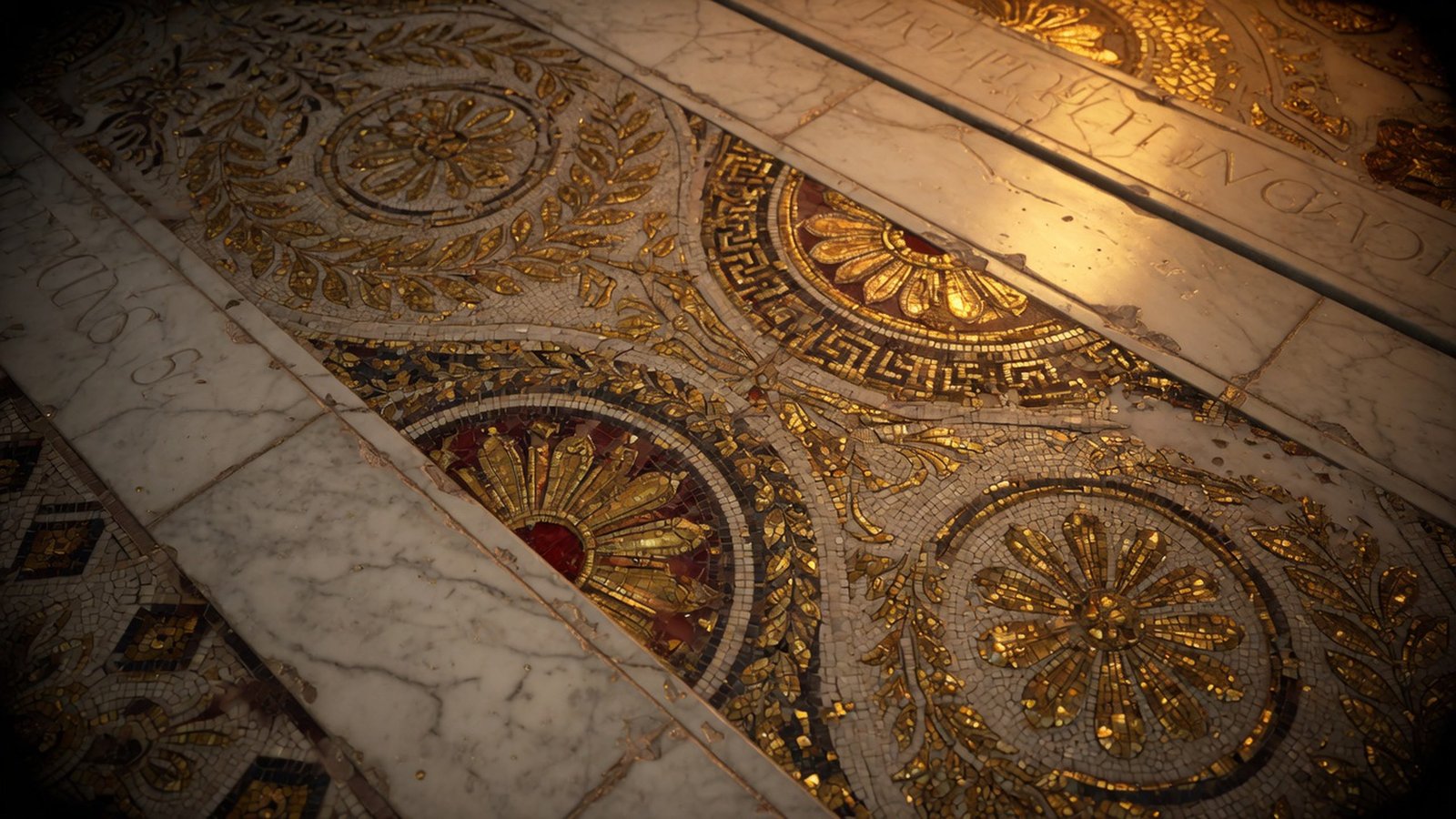
Greek and Roman cultures expanded gold’s role in coinage, jewellery and monumental art. Mosaics and gilding made gold a public language of power. Physicians and philosophers also wrote about metals and the body — early steps in a long conversation between material science and human wellbeing that would continue for centuries.
“Gold endures — and so does the human desire to understand it.”
Alchemy
Medieval and Renaissance alchemists sought the secrets of matter. Among their pursuits was aurum potabile — “drinkable gold” — preparations that aimed to dissolve or disperse gold into liquid form. Recipes mixed philosophy, symbolism and experimental craft.
These were not modern colloids by definition, yet they kept alive a powerful idea: that gold could be refined beyond the solid bar — into something finer, more intimate, more mysterious.

The turning point
The modern idea of colloidal gold begins when experiment replaces myth — without losing wonder.

Modern science
In the mid-19th century, Michael Faraday studied gold dispersions that glowed ruby-red in transmitted light — a phenomenon that revealed gold as fine particles suspended in liquid. His work helped found colloid science: the study of matter between true solution and coarse suspension.
The striking colour of colloidal gold is not a dye. It arises from how tiny gold particles interact with light — a physical signature of purity and scale.
Nanometre-range gold behaves differently from bulk metal.
Colour from light interaction — not artificial pigment.
A well-made colloid holds its dispersion with care and craft.
Key milestones
Egypt elevates gold as divine, eternal metal — leaf so fine it behaves like light.
Greece and Rome expand gold into coin, mosaic and monumental craft.
Alchemists pursue drinkable gold — philosophy meeting experimental fire.
Scientific study of ruby-red gold dispersions founds modern colloid thinking.
Instruments and theory refine particle size, stability and optical behaviour.
Small-batch makers unite heritage colour with modern purity standards.
Contemporary craft
Electron microscopy, spectroscopy and materials science transformed colloidal gold from curiosity into a precisely described system. Researchers mapped particle size, surface chemistry and optical response in extraordinary detail.
In parallel, a quieter culture of craft re-emerged: people seeking simple formulas, transparent ingredients and products that feel considered rather than noisy. Colloidal gold’s ruby colour — once a laboratory wonder — became a signature of purity you can see.

Made in Britain
Auria continues the long conversation with a deliberately simple formula: pure gold and purified water — 40 PPM, 250 ml, small-batch crafted. No dyes. No fillers. The ruby hue is the metal itself.
Continue exploring
History gives context. The bottle is for the present — a refined daily ritual, crafted in Britain.
Shop now
Private list
Join for atelier updates, new releases, and the occasional private offer — never spam.
Unsubscribe anytime. We respect your inbox.