Your bag is empty.
Continue shopping

Gold has fascinated people for thousands of years. Long before modern laboratories, chemical terminology, or advanced instruments, civilisations were already treating gold as more than ornament: a substance linked to permanence, refinement, and careful preparation.
Across ancient Egypt, India, China, Greece, the Islamic world, and medieval Europe, gold appears again and again — not only as currency or jewellery, but inside systems of ritual, medicine, and alchemical philosophy. In many cultures it was taken in elixirs, worked into specialised preparations, or studied by physicians and philosophers who saw it as the highest state of refinement in nature.
The consistency of that pattern is striking. Gold does not rust, corrode, or decay in ordinary conditions. That physical fact became a cultural metaphor: permanence, stability, longevity. From there, thinkers speculated that gold — prepared in particular ways — might speak to vitality or spiritual refinement. Whether those older frameworks were right is a separate question. That they kept returning to gold is historical fact.
Understanding gold in medicine means looking beyond modern supplement culture. The present interest in gold-based preparations is simply the latest chapter of a much older story: temple ritual, Ayurvedic metallurgy, Daoist experiment, medieval laboratories, Renaissance mineral medicine, and modern nanoscience.
For thousands of years, people explored the idea that the most stable and radiant of metals might hold deeper properties when refined. Today that curiosity continues in materials science and nanomedicine, where gold nanoparticles are studied for unusual optical and physical behaviour. This essay is education and history — not a product claim, and not medical advice.
Gold was never only a metal. Across cultures it became a symbol of purity, permanence, and refined life force.
Timeline: 5,000 years of gold as medicine
- c. 2500 BC — Gold appears in ritual and healing settings in ancient Egypt.
- Ancient India — Ayurvedic physicians develop refined gold preparations such as Swarna Bhasma.
- Ancient China — Daoist alchemists pursue golden elixirs linked to longevity and spiritual refinement.
- Classical Greece — Philosophers frame matter as transformable, shaping foundations of alchemy.
- Islamic Golden Age — Experimental alchemy expands through laboratory methods and preserved scholarship.
- Medieval Europe — Alchemists pursue aurum potabile, the legendary potable gold.
- Renaissance — Paracelsus develops mineral-based medicine and spagyric preparation.
- 19th century to present — Colloidal chemistry and gold nanoparticle research form a modern scientific bridge.
Ancient Egypt: gold as divine substance

Some of the earliest recorded uses of gold in ritual, symbolic, and healing contexts reach back thousands of years to ancient Egypt. In temple culture, gold was often treated as a physical expression of divine power — sometimes described as the “flesh of the gods,” a material of the eternal and incorruptible.
Because of that link with immortality and perfection, gold sat at the centre of burial rites, sacred objects, temple ornament, and ceremonies meant to preserve identity beyond death. It was not only luxury. It was a metaphysical language: what does not decay became a symbol of what transcends death.
That symbolism still matters when we read the long history of gold in medicine. Ancient thinkers did not split the world into our modern boxes of chemistry, spirituality, and therapeutics. A substance could be physically useful, ritually important, and cosmologically meaningful at once. Gold’s resistance to tarnish made it a natural emblem of permanence and order.
Some later accounts suggest Egyptian priest-scholars also explored finely divided gold or liquid gold elixirs in ritual purification. Alexandria later became a major intellectual crossroads, where Egyptian metallurgical knowledge met Greek philosophy and helped shape what would become Western alchemy.
Egypt’s legacy is a reminder that gold alchemy history did not begin in medieval Europe. Its roots run into temple cultures that treated gold as matter and meaning together. That spiritual weight still echoes whenever modern conversation turns to consciousness, subtle energy, or refinement — even when the laboratory has replaced the sanctuary.
India: Swarna Bhasma and the Rasayana tradition

One of the most sophisticated historical uses of gold as a prepared substance sits inside India’s Ayurvedic tradition. Ayurveda — often translated as the science of life — is among the oldest documented medical systems. Within it, metals and minerals were not always treated as inert bulk matter; they could be transformed through purification and preparation into agents of rejuvenation and vitality within classical frameworks.
Gold held a particularly high place. Physicians associated it with purity, stability, strength, and resilience — especially inside the branch known as Rasayana, concerned with rejuvenation, longevity, and long-term fortification of the body as those texts understood it.
In Ayurveda, gold was not simply admired. It was carefully transformed through complex purification processes into preparations associated with rejuvenation and vitality.
The most famous Ayurvedic gold preparation is Swarna Bhasma, a refined gold ash created through elaborate multi-stage procedures. Classical descriptions include purification, repeated heating, grinding, and treatment with herbal and mineral agents. The aim was not only mechanical powdering, but a more subtle form considered suitable for internal use within that system.
Those methods developed inside a broader Indian alchemical tradition called Rasa Shastra, combining metallurgy, mineral processing, herbal knowledge, and philosophies of purification. The transformation of metal mirrored, symbolically, the transformation of the person.
One of the most intriguing modern observations is that some analysed traditional samples contain extremely fine gold particles — occasionally in the nanometre range. That does not mean ancient practitioners were “doing nanotechnology” in the contemporary sense. It does suggest their metallurgy could produce forms of gold far more refined than solid metal pieces.
That bridge between ancient craft and modern curiosity is why discussions of gold in medicine so often return to Ayurveda: not because the frameworks are identical, but because both are interested in what happens when gold is made more subtle.
China: Daoist alchemy and the search for immortality

In ancient China, gold played a central role in Daoist alchemical traditions. Nature was not dead matter; it was a living process. Everything could be refined, transformed, and returned to a higher harmony with the Dao. Alchemy therefore concerned longevity, vitality, spiritual refinement, and the idea that a person could be remade through disciplined practice. Emperors and elites sometimes sponsored alchemists to pursue elixirs and methods thought to extend life.
Daoist alchemy treated gold as a model of perfected matter — stable, luminous, resistant to decay.
The tradition developed two major branches: Waidan (outer alchemy) and Neidan (inner alchemy). Waidan involved laboratory work with minerals, crucibles, furnaces, and elixirs. Neidan turned the process inward — breath, meditation, subtle cultivation — keeping alchemical language while making the body the laboratory.
Gold kept appearing not only as an ingredient, but as a symbol of what the practitioner hoped to become: stable, refined, luminous, resistant to corruption. Perfected matter became a model for perfected life.
Some Waidan traditions prepared mineral elixirs involving gold, cinnabar, and other substances, intended to harmonise body and cosmos. Not all experiments were safe — toxic minerals could be involved — but historically they show a serious attempt to transform metals into preparations meant for living systems, not inert ornaments.
Neidan went further: the golden elixir became an inner process. The point was not only to swallow an elixir, but to cultivate one through internal refinement. Daoism remains one of the richest historical examples of gold as both medicine and spiritual technology.
Greek and Arabic alchemy: transformation, perfection, purification
As knowledge moved west through trade and exchange, Egyptian and Eastern ideas influenced Greek philosophers and later Islamic scholars. The Mediterranean became a crossroads where metallurgy, cosmology, and philosophy fused into the tradition later called alchemy.
Greek thinkers asked what matter is made of. Aristotelian thought treated earth, water, air, and fire as primary and transformable. If substances shared building blocks, one might become another through purification and controlled change. Gold, which does not rust or degrade like iron or copper, stood as the most perfect metal — the natural symbol of refined matter.
Base metals were not wholly other than gold; they were unfinished. Alchemy tried to accelerate nature’s refinement. The journey from lead to gold also became a metaphor: ignorance to insight, imbalance to harmony, fragmentation to completion.
In the Islamic Golden Age, scholars preserved, translated, and expanded earlier alchemical knowledge. Experiment became more systematic. Distillation, filtration, crystallisation, and sublimation were refined and documented with greater precision. Figures associated with the Geber tradition helped move chemical thinking forward.
This era matters for gold in medicine because philosophy became more experimental. Metals were not only symbols; they were processed, dissolved, separated, heated, purified, and recombined. The dream of transformation began producing methods that would later support chemistry itself.
Medieval Europe: potable gold and the alchemists

By the medieval period, alchemy was widespread in Europe. Knowledge that had travelled through Greek philosophy and the Islamic world was translated into Latin and studied in monasteries, courts, and early universities. It sat between philosophy, medicine, metallurgy, natural science, and spiritual symbolism — not “fringe” in the modern sense.
One of the most compelling ideas of the era was aurum potabile — potable gold. If gold could be made drinkable, some believed, its incorruptible nature might be transmitted to the body. Because gold did not tarnish, it modelled balance and permanence. Internalising its “essence” might preserve vitality.
Potable gold reflected an ancient question that still echoes: what happens when gold is refined into a more subtle and interactive form?
Descriptions varied. Some attempts used acids; others tried to suspend fine particles in liquid. Some preparations were ineffective, some uncertain, some hazardous. Historically they still matter: they show a repeated impulse to turn gold into something active, not merely decorative.
In spirit, aurum potabile is one of the clearest ancestors of modern talk about refined gold preparations. Language, methods, and standards differ; the curiosity is familiar. How does gold behave when it is no longer a rigid mass?
Potable gold was also bound up with the legend of the Philosopher’s Stone — a substance said to perfect matter, transform base metals, and in some traditions yield an elixir of life. Literal or symbolic, the Stone stood for ultimate refinement.
Modern interest in gold elixirs and refined mineral preparations is not a novelty. It sits in a long current where gold bridges matter, vitality, and transcendence.
Paracelsus and spagyric medicine

One of the most important figures in Renaissance medicine and alchemy was Paracelsus (Theophrastus von Hohenheim, b. 1493). He challenged humoral orthodoxy, arguing that illness could arise from chemical disturbance and that medicine should rest on observation, experiment, and transformation.
That was a turning point for gold in medicine. Paracelsus did not dismiss metals as inert. He held that minerals, metals, and plants carried hidden properties unlocked by proper preparation. Nature’s substances contained beneficial and harmful elements; the practitioner’s task was to separate, purify, and recombine them into more balanced form.
Paracelsus helped shift alchemy toward medicine, arguing that metals and minerals could be prepared in ways that supported healing rather than remaining inert bulk.
This became known as spagyric medicine — from Greek roots meaning to separate and recombine. Calcination, distillation, extraction, and recombination were used to isolate what practitioners saw as essential virtues while leaving the crude behind.
Gold held a special place: the most refined and stable metal, symbol of order and durable vitality. Paracelsus described mineral preparations in ways that moved alchemy toward chemical medicine. Symbolic language remained; laboratory process moved closer to practical therapeutics.
He stands on the threshold between medieval alchemy and emerging science. He did not erase the old language of transformation; he made it experimental.
From alchemy to chemistry: origins of modern mineral preparations
Across millennia and civilisations, gold returns in connection with health, vitality, and transformation — Egyptian temple practice, Indian Rasayana, Chinese experiment, European laboratories. Traditions differed, yet shared a similar intuition: gold’s unique qualities might become more accessible when the metal is refined, purified, dissolved, suspended, calcined, or otherwise transformed.
The shift from alchemy to modern chemistry was gradual. Techniques first polished in alchemical workshops — distillation, controlled heating, separation, filtration, crystallisation — became scientific tools. Symbolic language faded; practical method endured.
So the history of alchemy and gold is not only a story of old belief. It is part of the prehistory of chemistry, pharmacology, and materials science. Fascination with transformation, disciplined by experiment, helped build modern practice.
Modern science: gold nanoparticles, colloidal gold, and nanomedicine

Modern nanoscience has revealed something older traditions long suspected: gold behaves very differently when transformed into highly refined forms.
To balance history with evidence, end with what science can actually say. Today gold is studied not only as symbol, but as an unusual material at the nanoscale. When reduced to extremely small particles, it interacts with light, surfaces, and surrounding environments differently because size, surface area, and structure matter.
Nineteenth-century colloidal chemistry made that shift visible. Michael Faraday studied finely dispersed gold in liquid and observed the striking ruby colour associated with very small particles — now explained through nanoscale optics rather than ancient symbolism, but still driven by the same curiosity: refined gold is not bulk gold.
Contemporary research explores gold nanoparticles in nanomedicine, diagnostics, imaging, biosensing, and materials science — as carriers, contrast agents, or components of engineered systems. These are technical fields. They should not be confused with broad historical or spiritual claims, or with consumer product promises. They do show that gold remains scientifically compelling when made subtle.
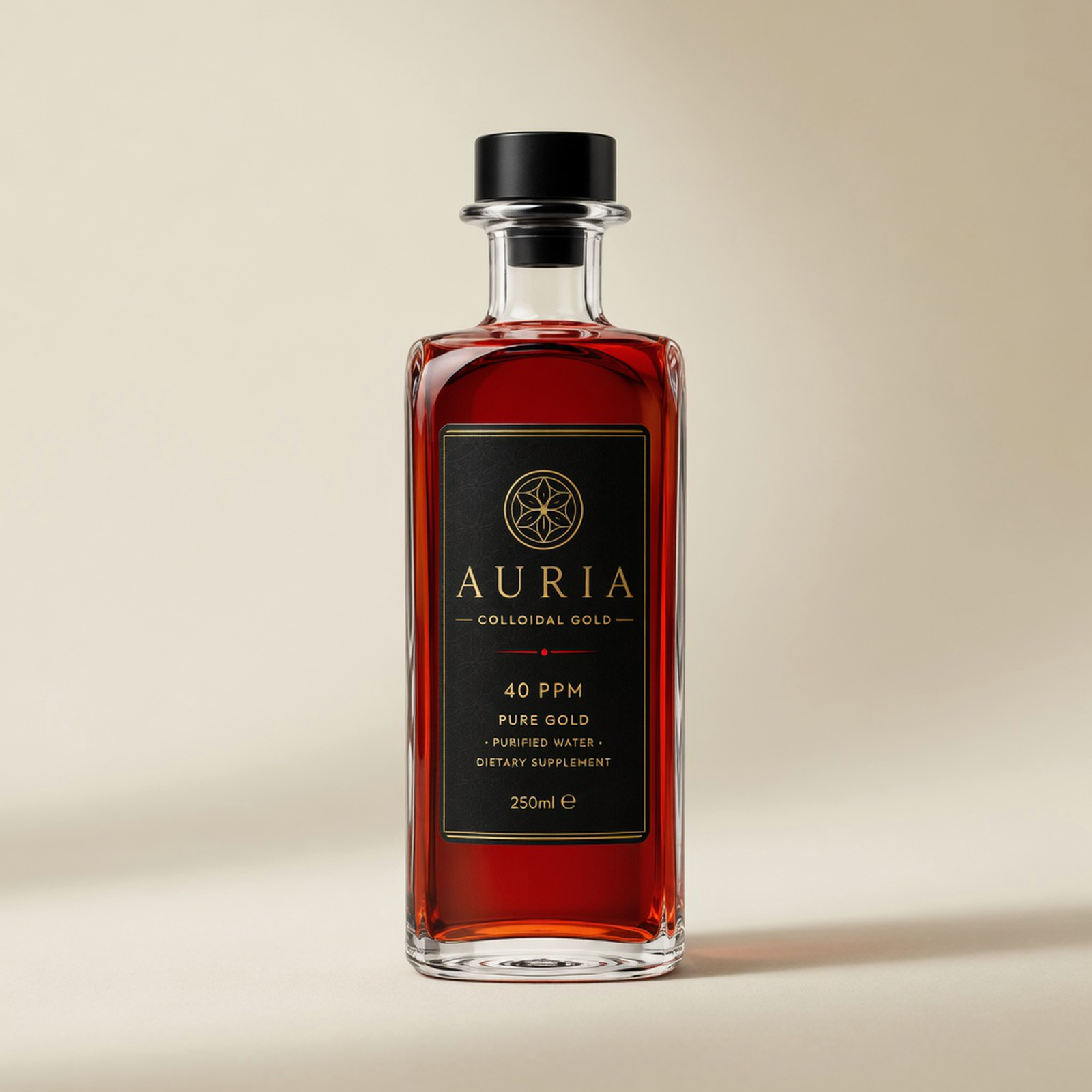
For readers of Auria’s journal, this is the honest bridge: Faraday’s “divided gold,” modern colloidal craft, and a short-formula bottle of elemental gold in purified water sit in one continuous story of refinement — without pretending the temple and the laboratory are the same place.
If you want the Faraday chapter in full, read our essay on Michael Faraday and the birth of colloidal gold. For the product facts behind Auria’s bottle, see what colloidal gold is and our process.
Why gold still holds the human imagination
Gold has always occupied a unique place in culture. It does not rust or visibly degrade like most metals. It holds light and keeps its appearance across centuries. Those physical properties helped establish it as a symbol of permanence, purity, and perfection in many civilisations.
Because of that, gold became more than metal. It became a language of transformation. In alchemy, gold was the final stage of refinement — stable balance. Turning base metal into gold was also a metaphor for refining consciousness itself.
The story of gold in medicine is really a story of refinement — from temple ritual and alchemy to colloidal chemistry and nanotechnology.
That is why the subject still captivates. Gold sits where history, symbolism, medicine, materials science, and human longing meet. Few substances can carry temple myth, medieval lore, Renaissance mineral medicine, and nanotechnology in one thread.
Modern interest in colloidal gold is not isolated. It belongs to a longer narrative. What began in temples, furnaces, and philosophical schools continues in laboratories and careful craft. Across all of it, one idea stays remarkably consistent: gold invites us to think about what refinement really means.
Frequently asked questions
Did ancient civilisations really use gold in medicine?
Yes. Historical traditions in Egypt, India, China, and later Europe include gold in ritual, medicinal, or alchemical contexts. Meanings and methods varied widely, but gold repeatedly appears alongside vitality, longevity, and refinement.
What is Swarna Bhasma?
A traditional Ayurvedic preparation of gold purified and processed through repeated heating, grinding, and herbal treatment — one of the best-known historical examples of refined gold in a medical system.
What is aurum potabile or potable gold?
Aurum potabile means drinkable gold. Medieval alchemists used the term for liquid preparations derived from gold, hoping the metal’s incorruptible nature might be shared with the body.
Why was gold linked to immortality?
Gold resists corrosion and keeps its brilliance. Ancient cultures read those physical qualities symbolically as permanence, divine power, and perfected matter.
Is Daoist alchemy the same as modern chemistry?
No. Daoist alchemy is a historical spiritual and philosophical tradition. Outer alchemy involved real material experimentation; inner alchemy focused on meditation and internal refinement.
How did Paracelsus change the history of gold in medicine?
He moved alchemy closer to chemical medicine through observation, laboratory preparation, mineral remedies, and purification of natural substances — a bridge between medieval alchemy and early pharmacology.
What is the modern scientific equivalent of ancient gold elixirs?
There is no one-to-one equivalent. Modern colloidal gold and gold nanoparticle research are contemporary scientific explorations of gold in refined, highly dispersed forms — distinct from historical or spiritual claims.
Why does gold still matter today?
Because it is historically rich, symbolically powerful, and scientifically unusual: studied in materials science and nanomedicine while still carrying cultural weight. Auria’s interest is craft and clarity — short formulas, honest process — not miracle language.
References and further reading
- Historical and clinical overviews of gold compounds in medicine (scholarly reviews).
- Physicochemical characterisation studies of traditional Swarna Bhasma preparations.
- Literature on nanostructured gold in traditional Ayurvedic samples.
- Overviews of Rasayana traditions in Ayurveda.
- Stanford Encyclopedia of Philosophy: Religious Daoism.
- Encyclopaedia Britannica entries on Neidan, the history of alchemy, the Philosopher’s Stone, and Paracelsus.
- Recent reviews of gold nanoparticles in biomedical research applications.
- Royal Institution materials on Michael Faraday’s gold colloids; Faraday’s 1857 Bakerian Lecture on gold and light.
Educational history only. Auria Colloidal Gold is a food supplement. It is not intended to diagnose, treat, cure, or prevent disease. Always seek qualified professional advice before using any supplement if you are pregnant, breastfeeding, taking medication, or managing a medical condition.