Your bag is empty.
Continue shopping

Before laboratory certificates and QR codes, people judged value with their eyes. Tyrian purple meant wealth because the dye was punishing to produce. Deep red wine in the right vessel meant a careful cellar. And certain preparations of gold — suspensions and colloids that catch light like a dark ruby — carried a reputation that outlived the empires that first chased them. Colour was never only decoration. Colour was a quality signal.
That history is stranger and more interesting than modern marketing usually allows. It is also useful. If you understand why humans learned to trust certain colours, you become harder to fool with dyes, filters, and “premium” gradients on a product page.
Purple, red, and the economics of difficulty

In the ancient Mediterranean, purple extracted from murex snails was legendary for a practical reason: it took a grotesque amount of work. Scarcity was baked into the process. Red pigments from minerals and insects had their own supply chains, trade routes, and counterfeits. Wherever a colour was hard to make, status followed — and so did fraud.
Gold sat in a different category. As a metal it was dense, incorruptible, and recognisable. As a colour in liquid, it behaved less obediently. Finely divided gold does not always look “golden.” Depending on particle size and the way light scatters, gold dispersions can appear red, purple, or brown. The famous ruby glass of later European craft — gold chloride in glass melts — made that physics permanent in windows and goblets. The lesson travelled: sometimes the most valuable yellow metal looks like a jewel from another part of the spectrum.
From workshop lore to laboratory language
Alchemists and early chemists were often wrong about theory and occasionally right about technique. They learned that gold could be dissolved, reduced, and dispersed; that stability depended on careful process; that the eye could catch differences the tongue could not. When modern science reframed those observations in the language of nanoparticles and surface plasmon resonance, the old workshop lore did not become useless. It became explainable.
Explanation matters because it separates romance from specification. “Liquid gold” as poetry is ancient. Colloidal gold as a controlled dispersion of elemental gold in a purified medium is a modern, testable idea. The two share a colour story. They do not share a method of accountability.
That is why serious makers still talk about PPM, process, and purity instead of mythology alone. Mythology opens the door. Measurement decides whether you should walk through it.
What ruby colour is — and is not

A ruby or deep red appearance in a gold preparation is often associated with particular particle characteristics and clean formulation. It is not, by itself, a certificate of miracles. Colour can vary with concentration, particle size distribution, container, and lighting. Two honest products can look slightly different; a dishonest product can be tinted to look the part.
So how should a careful buyer use colour?
- As a consistency check — batch to batch, does the maker’s product look like itself?
- As a transparency check — can you see the liquid clearly in glass under ordinary light?
- Never as the only check — ask what is in it, how it is made, and what is deliberately left out.
The historical eye was sophisticated for its time. Your eye can be sophisticated for ours: curious, not credulous.
Ritual objects and the human need for thresholds
Gold’s cultural power was never only economic. Wedding bands, reliquaries, illuminated manuscripts, funerary masks — gold marks thresholds: vows, death, devotion, crowning. Even people who reject luxury as a value system still understand the gesture of setting something apart.
Daily wellness culture, at its best, is a democratised version of that gesture. You take a few minutes. You use a vessel that is not a crumpled can. You pay attention. At its worst, the same culture sells threshold aesthetics without threshold behaviour — gold-coloured packaging for a hurried gulp over a keyboard.
History suggests the behaviour is the durable part. Empires change. The human nervous system still responds to pause, weight, light, and repetition.
Britain, craft, and the modern preference for short formulas

There is a quiet craft tradition in Britain that distrusts unnecessary ornament: good wool, plain silver, well-made tools, formulas that do not apologise for being short. That sensibility maps cleanly onto contemporary ingredient minimalism. If pure gold and purified water can constitute a complete preparation at a stated concentration — for Auria, a target of 40 PPM — then the craft is in the making and the control, not in a paragraph of botanical name-dropping.
This is where history and modern branding either shake hands or fall out. A brand that borrows Egyptian baths and Roman banquets without borrowing discipline is costume jewellery. A brand that treats gold with workshop seriousness — simple inputs, careful process, protective glass — is continuing a longer line than any campaign can invent.
How to read a modern “gold” product page
Use a historian’s suspicion and a scientist’s checklist:
- Inputs — elemental gold and water is a clear story; a fog of additives is a different product category.
- Concentration language — look for clear units (such as PPM), not only adjectives.
- Container — glass that lets you see the liquid is aligned with the colour-as-signal tradition.
- Claims — prefer process and purity language over medical theatre.
- Origin and making — “where” and “how” beat “ancient secret” every time.
You are not rejecting wonder. You are refusing counterfeit wonder.
Colour as a teacher
Walk past a stained-glass window late in the day and you will understand more about value than a dozen product adjectives can teach. Light has to travel through something carefully made. The red that survives is not random. Someone chose materials, temperatures, and tolerances so that a colour could hold.
Colloidal gold’s ruby associations sit in that same family of ideas: matter arranged carefully enough that light becomes information. Whether you come to the subject as a history reader, a design lover, or someone building a small daily ritual, the useful inheritance is the same. Demand process. Enjoy beauty. Do not confuse the two — and do not settle for either one alone.
The old world used colour because it could not open a lab report. The new world can open a lab report and still love colour. That combination — clear inputs, visible liquid, restrained story — is what makes a modern gold preparation feel continuous with craft rather than costume.
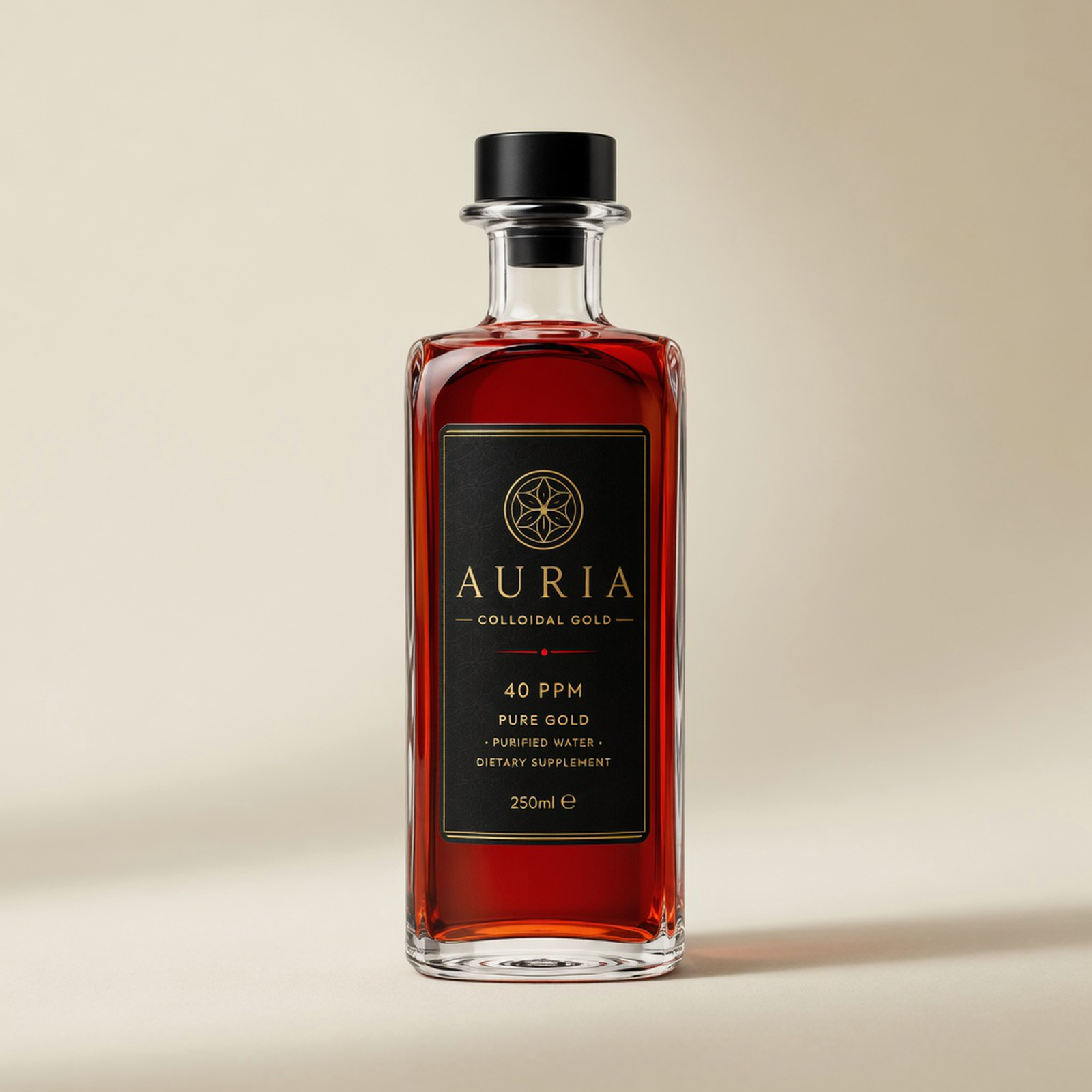
See a contemporary expression of that craft: Auria Colloidal Gold — pure gold and purified water, 40 PPM, glass-bottled in Britain.